
Shopping cart
 Lamp with Gold Base$149.99
 Tea table$139.99
 Recliner chair$109.99
 Recliner chair$100.00
 Bathtub$99.99
Search here...

About us
Get the oars in the water and start rowing. Execution is the single biggest factor in achievement so the faster and better your execution.
About Us
Download PDFThe Devasthan Department is dedicated to the preservation and promotion of temple culture. This department was established in 1949, following the integration of 22 princely states of the former Rajputana into the newly formed State of Rajasthan. Its primary objective was to manage and ensure the smooth functioning of temples, monasteries, dharamshalas (pilgrim rest houses), etc., that were formerly operated by these princely states through their respective treasuries.
Rajasthan's glorious past is renowned for the religious devotion and sacrifices of its former rulers. Many rulers of these princely states considered themselves not as sovereigns, but as custodians serving their chosen deities, ruling under seals and coins bearing the names of these deities. As a result, a vast number of temples, religious sites, and dharamshalas were constructed not only within Rajasthan but also in other parts of the country by these royal families.
Temples and religious sites at various pilgrimage locations have, since medieval times, served as centers for religious, moral, social, spiritual, and educational activities. Through these institutions, disciplines such as astrology, Ayurveda, rituals, religious scriptures, music, sculpture, painting, folk songs, bhajans, and traditional dance have been preserved, promoted, and taught. These centers have also supported and protected numerous scholars, destitutes, students, and saints over time. Even amidst changing societal dynamics, these temples continue to play a vital role in fostering religious harmony and meeting social needs. These unique repositories of ancient architecture, sculpture, and art galleries represent invaluable treasures of modern India.
With the formation of the new state of Rajasthan, the responsibility for managing and preserving this vast temple heritage was entrusted to the present-day Devasthan Department.
The department continues to regulate such religious and charitable institutions and government temples, monasteries, and public trusts inherited through this legacy. It also guides their administration and offers financial assistance as part of its religious and social obligations. Initially, the department was primarily seen as responsible for temple rituals and property management. However, with changing times, the state government has progressively expanded its scope and assigned new responsibilities.
Around a decade after the formation of the state, the Rajasthan Public Trust Act, 1959 was enacted, and the department was entrusted with the responsibilities of trust registration, complaint investigation, and supervision.
Similarly, following land reform programs, the department also assumed responsibility for managing reacquired temple and monastery lands, disbursing fixed annual compensations, and providing grants and assistance to religious institutions.
Over time, the state government has increased the department’s budget, initiated and implemented major renovation and conservation projects for temples and institutions. The department has not only developed its own temples and institutions but has also contributed to the development of temples managed by trusts and other religious sites. Significant investments have also been made to enhance infrastructure such as temple complexes, roads, drainage, and pilgrim rest facilities.
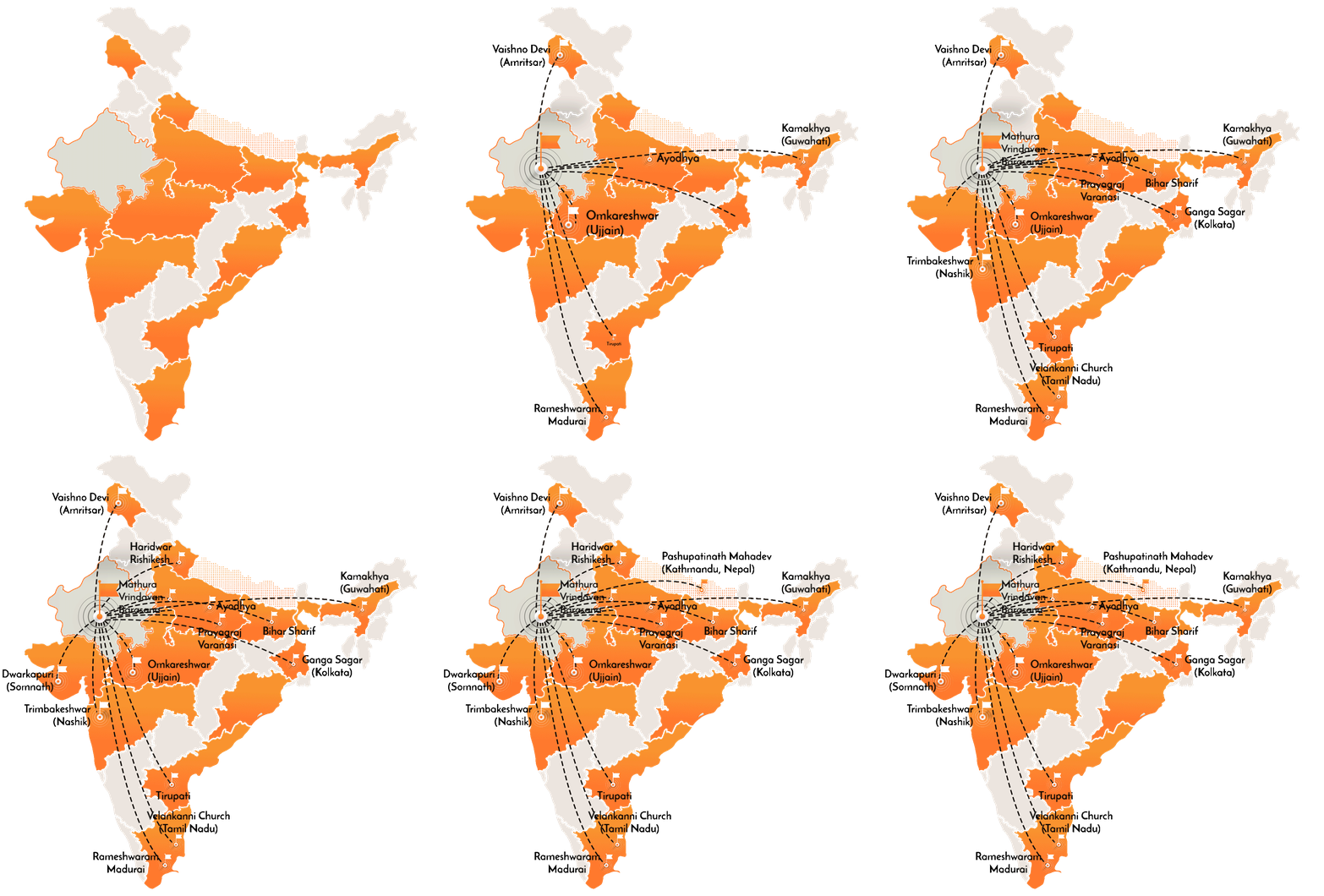
In line with the government’s new policy to promote religious tourism and pilgrimages, new schemes have been launched. Multiple programs are now being run to facilitate free pilgrimages for Rajasthan residents to major religious destinations across India.
For the financial year 2024–25, the estimated target is 36,000 pilgrims (30,000 by train and 6,000 by air), with a proposed budget of ₹86 crore and an allocated budget of ₹50 crore. Out of the train quota,15,000 senior citizens will be taken for darshan of Shri Ram Temple in Ayodhya.
The department is progressing toward modernization to meet contemporary needs. Most information is now publicly accessible via the department’s portal, and all departmental services are being transitioned to online platforms.
- Rameshwaram-Madurai
- Jagannath Puri
- Tirupati
- Dwarkapuri-Somnath
- Vaishno Devi-Amritsar
- Prayagraj-Varanasi
- Mathura-Vrindavan-Barasana
- Sammed Shikhar-Pawapuri-Baidna
- Ujjain-Omkareshwar-Trimbakeshwar (Nashik)
- Ganga Sagar (Kolkata)
- Kamakhya (Guwahati)
- Haridwar-Rishikesh-Ayodhya
- Mathura-Ayodhya
- Bihar Sharif
- Velankanni Church (Tamil Nadu)
- Pashupatinath Mahadev (Kathmandu, Nepal)